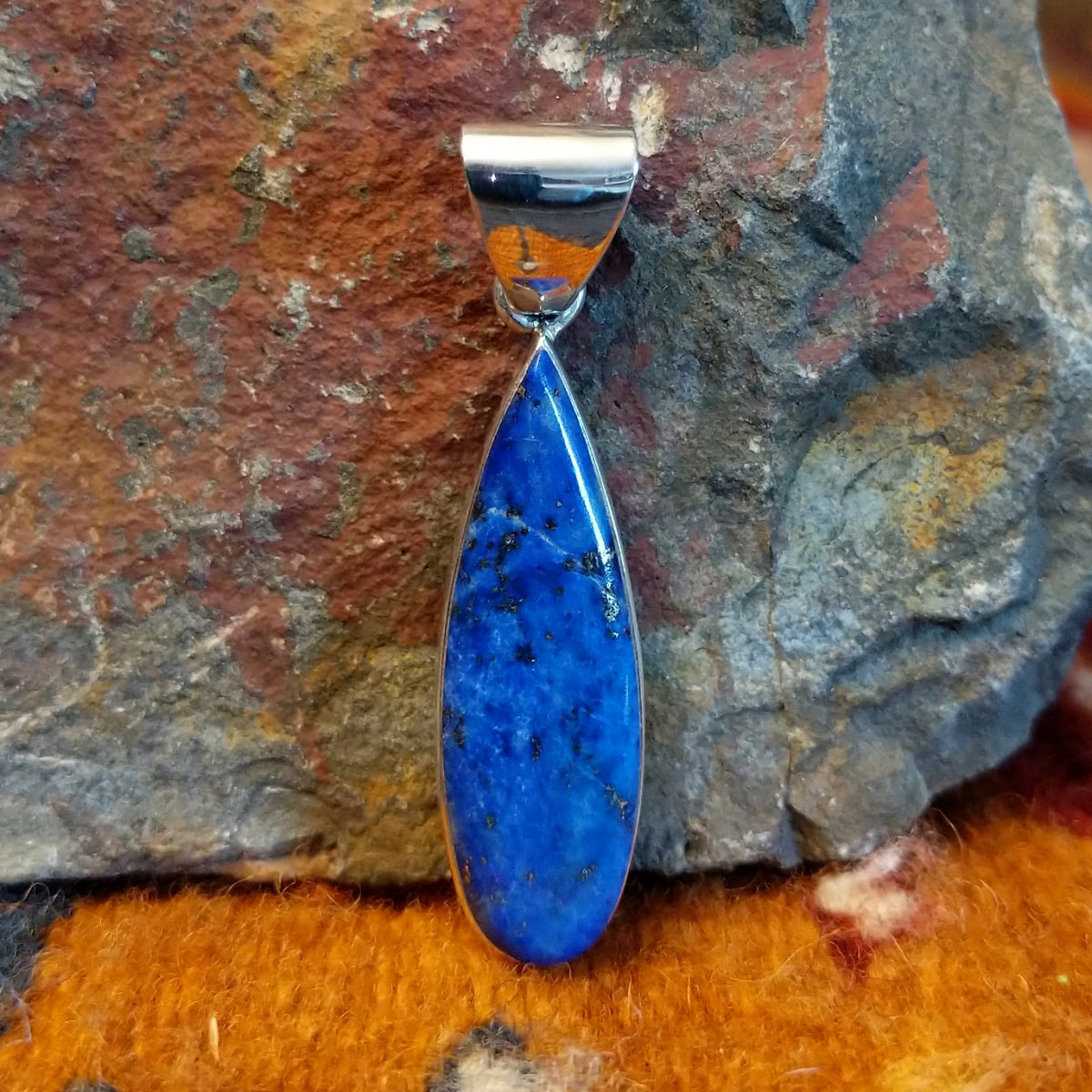
Lapis Lazuli
Lapis Lazuli, commonly called Lapis, is a treasured deep-blue ornamental gemstone known for its intense royal-blue and ultramarine coloration, often accented by shimmering golden pyrite inclusions and subtle white calcite veining.
Prized for thousands of years, Lapis Lazuli is admired for its rich color and striking natural patterns. Its bold blue tones create a beautiful contrast when paired with sterling silver, making it a popular choice for Native American and Southwestern jewelry.
Distinctive characteristics
-
Color: Deep royal blue, ultramarine, and rich midnight blue.
-
Matrix: Golden metallic pyrite flecks and occasional white calcite veins.
-
Composition: A metamorphic rock composed primarily of lazurite, with calcite, pyrite, and other minerals.
-
Appearance: Opaque, with a smooth, polished finish and occasional sparkling golden inclusions.
-
Hardness: Approximately 5–5.5 on the Mohs scale.
-
Jewelry: Popular in sterling silver rings, pendants, earrings, bracelets, necklaces, and Southwestern jewelry.
Where is Lapis Lazuli found?
Lapis Lazuli is mined in several locations worldwide, with the most famous deposits found in:
-
Afghanistan: The Badakhshan region, especially the Sar-e-Sang mines, is renowned for exceptional deep-blue Lapis Lazuli and has supplied the gemstone for thousands of years.
-
Chile: The Andes Mountains, particularly the Coquimbo region, are an important source of Lapis Lazuli.
-
Russia: Deposits near Lake Baikal in Siberia.
-
Pakistan: Found in mountainous northern regions.
-
Tajikistan: Deposits in Central Asia.